A few years back, a close friend of mine left a hospital admin job to join the county health department. Her first question to me was: “Is the pay going to kill me?” Honestly, I didn’t have a straight answer. The salary stuff in public health is genuinely confusing — it varies wildly by state, county, role, and sometimes just who’s doing the hiring. So I did what any curious person would do: I dug in, talked to people, and eventually worked alongside health department staff long enough to get a real picture.
This is what I found out. No fluff, no “it depends” cop-outs — just actual numbers, real tradeoffs, and the stuff HR brochures never bother to say.
First, Let’s Be Honest About What “Health Department” Covers
This is where a lot of people trip up. When someone says “health department employee,” they could mean a county-level epidemiologist tracking a disease outbreak, a state-level health officer setting policy, a school nurse under a public health contract, a sanitation inspector, or a community outreach coordinator running diabetes prevention programs.
The range is enormous. And the pay reflects that. So before we talk numbers, know that the title “health department employee” is a category, not a job.
The biggest mistake people make is comparing their health department offer to a hospital salary. They’re completely different ecosystems — different funding sources, different pay structures, different everything.
The Actual Salary Ranges (by Role)
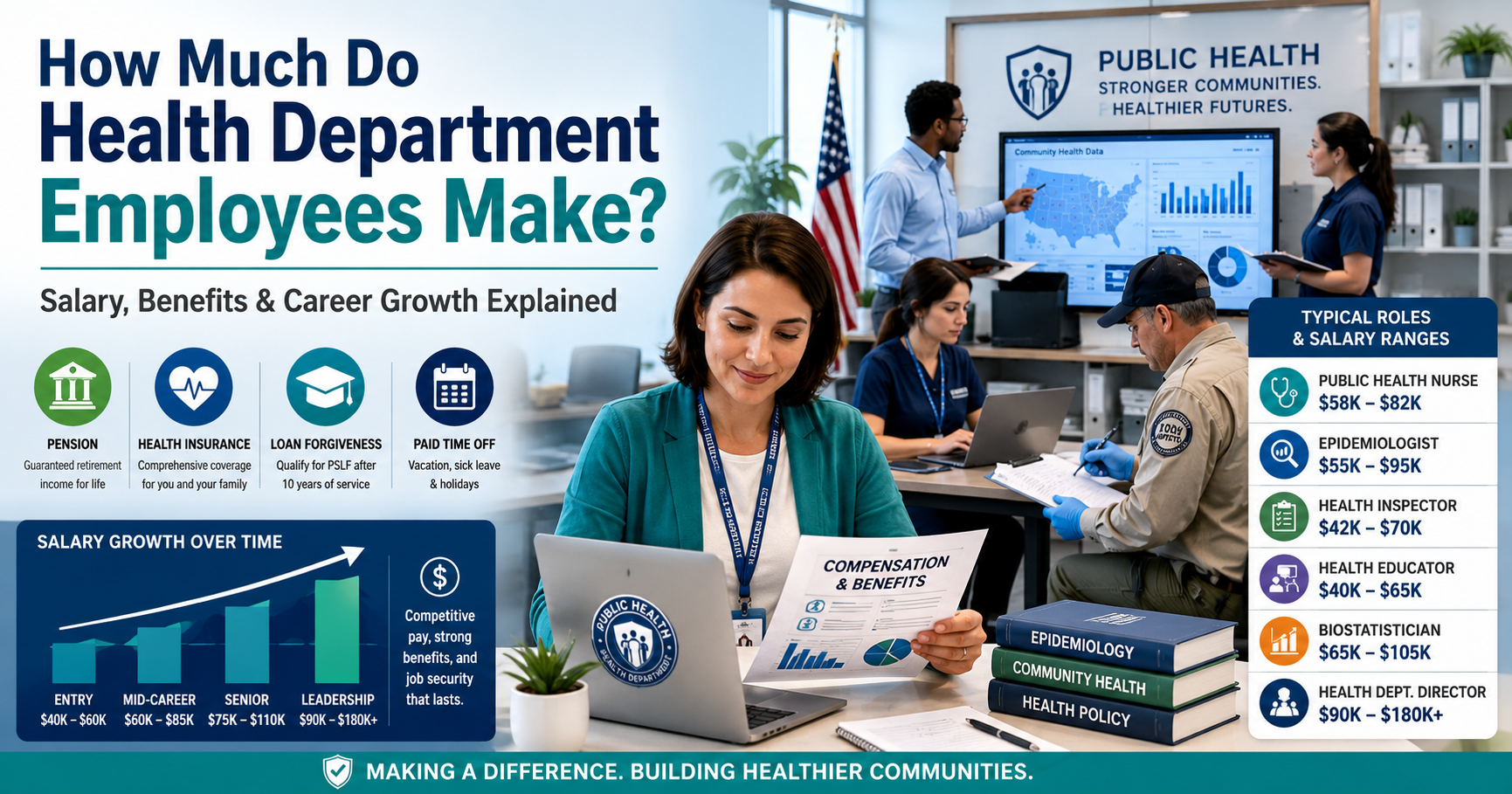
Here’s a practical breakdown based on U.S. figures. These are realistic mid-range estimates — entry to senior level — not the cherry-picked high numbers you see on some job boards.
| Public Health Nurse | $58K–$82K |
| Epidemiologist | $55K–$95K |
| Health Inspector | $42K–$70K |
| Health Educator | $40K–$65K |
| Biostatistician | $65K–$105K |
| Health Dept. Director | $90K–$180K |
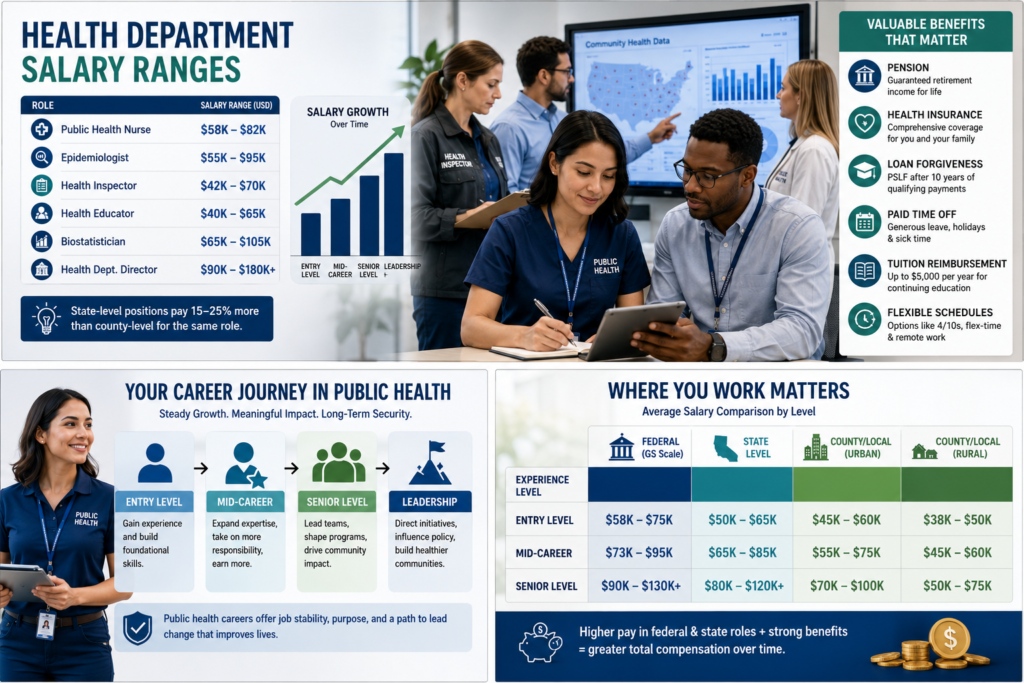
State-level positions tend to pay 15–25% more than county-level for the same title. And if you’re in California, New York, or Washington, add another 20–30% on top of that. Meanwhile, rural counties in the South or Midwest can pay significantly less — sometimes $10–15K under the national median.
Where Health Departments Genuinely Win: The Benefits
Here’s where the honest conversation gets interesting. My friend who made the switch? She took a $7,000 pay cut. Two years in, she told me she’d never go back. Why? The benefits package changed the math completely.
Government jobs — including health departments — typically come with a benefits stack that private employers just can’t match without paying you a fortune. Let’s break it down.
That pension is a big deal that younger applicants often overlook. Most public health positions are government roles, so they come with a defined benefit pension — meaning you’re guaranteed a percentage of your salary for life in retirement, rather than hoping a 401(k) performs well. Over a 25–30 year career, the pension alone can be worth hundreds of thousands of dollars more than a comparable private-sector retirement plan.
Benefits that often get overlooked
›Loan forgiveness: Public Service Loan Forgiveness (PSLF) applies to most government health department positions. After 120 qualifying payments (~10 years), your federal student loans are forgiven. For someone with $60K in student debt, this can be worth more than a $6,000/year raise.
›Sabbatical/study leave: Many state health departments offer paid study leave for continuing education, conferences, or advanced degrees.
›Tuition reimbursement: Common in larger health departments — often $2,000–$5,000/year toward graduate coursework.
›Compressed schedules: 4/10 (four 10-hour days) and flex-time arrangements are common, especially post-2020.
How Pay Actually Progresses Over a Career
This is one area where public health is genuinely different from hospital or clinic work. Advancement in a health department tends to be slower and more structured — but it’s also more predictable.
Most civil service positions operate on a “step and grade” system. You start at a grade (say, Grade 18) and move up one step every 1–2 years automatically, as long as your performance is satisfactory. No negotiating, no office politics about who gets the raise. There are usually 8–10 steps per grade, meaning a 15–20% raise just through time served.
Promotions to a higher grade require either applying for a new position or internal reclassification — which can be slow. I’ve spoken to environmental health specialists who were stuck at the same grade for six years waiting for a supervisor role to open up. That’s the real frustration: the ceiling exists, and it can feel close.
If you’re driven by salary growth, the first decade of a health department career can feel like slow going. The second decade is where the compound value — pension, job security, leave accumulation — really starts to show up.
Federal vs. State vs. County: Does It Matter Where You Work?
Massively. Here’s a quick hierarchy to understand:
Federal positions (CDC, NIH, HHS, FDA) follow the GS pay scale. A GS-11 epidemiologist in Atlanta starts around $73K. That same position in San Francisco would be around $88K due to locality pay adjustments. Federal benefits are generally considered the gold standard — FEHB health coverage is excellent, the TSP retirement plan is strong, and job security is high.
State health departments vary enormously. Massachusetts, California, and Minnesota tend to pay well and have strong benefits. Mississippi, Arkansas, and West Virginia pay notably less, though cost of living adjustments matter too.
County and local health departments are where most public health workers actually work day-to-day — and they’re the most variable. A large urban county (Cook County in Illinois, LA County in California) can pay comparably to state jobs. A small rural county might offer salaries that feel like a step back even from community college staff positions.
Common Mistakes People Make When Evaluating These Jobs
Comparing base salary only. When someone says “I turned down a health department job because it paid $10K less than a hospital position,” they’re probably comparing apples to oranges. Factor in pension contributions (often equivalent to 12–18% of salary), loan forgiveness, and premium health coverage. The total compensation picture looks different.
Ignoring overtime and differential rules. Public health emergencies — COVID being the obvious recent example — can involve extended hours. Government employees are typically paid overtime under FLSA rules or get comp time. Some nurses and inspectors have meaningfully boosted their annual income during outbreak response periods.
Not checking union coverage. In many states, health department employees are covered by public employee unions (AFSCME, SEIU, or nursing-specific unions). This matters for pay negotiations, grievance processes, and layoff protections. A unionized county health department job carries significantly more job stability than a grant-funded nonprofit role, even if the base pay looks similar.
Underestimating geographic variation. Two people with the same title — Public Health Nurse — can be earning $54K in one state and $91K in another. Always look up the specific posting’s pay band, not just the national average.
How to Research the Actual Pay Before Applying
If you’re seriously considering a health department position, here’s a practical process that actually works:
Step-by-step research process
- Look up the specific position’s grade or classification on the department’s HR page. Most state and federal agencies publish their full pay scales publicly.
- For federal roles, use the OPM’s pay tables (opm.gov) and look up your locality area. The difference between base and locality-adjusted pay can be 15–35%.
- Check sites like Transparent California, Open Payrolls, or your state’s equivalent — many states are legally required to post actual salaries for public employees. Real numbers, not ranges.
- Find people on LinkedIn who have the exact role in that county or state and message them directly. Public health professionals are surprisingly willing to share salary info — there’s a cultural norm of transparency around public wages.
5Before accepting any offer, ask HR for a complete benefits summary document — not a brochure, the actual plan documents. This tells you the real story on health insurance deductibles, pension vesting schedules, and leave accrual.
Is a Health Department Job Worth It Financially?
Depends entirely on where you are in your career and what you’re optimizing for. For someone early-career with student debt, a government health position can be the financially smartest move they make — the loan forgiveness alone can outweigh a $15K salary differential. For someone mid-career with no debt, chasing a higher private salary while building up a 401(k) might make more sense.
The people I’ve seen most satisfied with health department careers tend to be those who factored in the full picture early. They took the job knowing the base pay was modest, but banked on the pension, the stability, and the loan forgiveness working in their favor over 10+ years. And most of them were right.
What tends to disappoint people is taking the job expecting the salary to catch up to private sector over time. It generally doesn’t — at least not on the base pay line. The advantage is in the benefits and the long game.
The one thing I’d leave you with: if you’re genuinely interested in public health work, don’t let a surface-level salary comparison scare you off. Run the full math first. And if you’re in the field and feel underpaid, check whether your position qualifies for PSLF — there’s a good chance you’re leaving money on the table without even knowing it.